
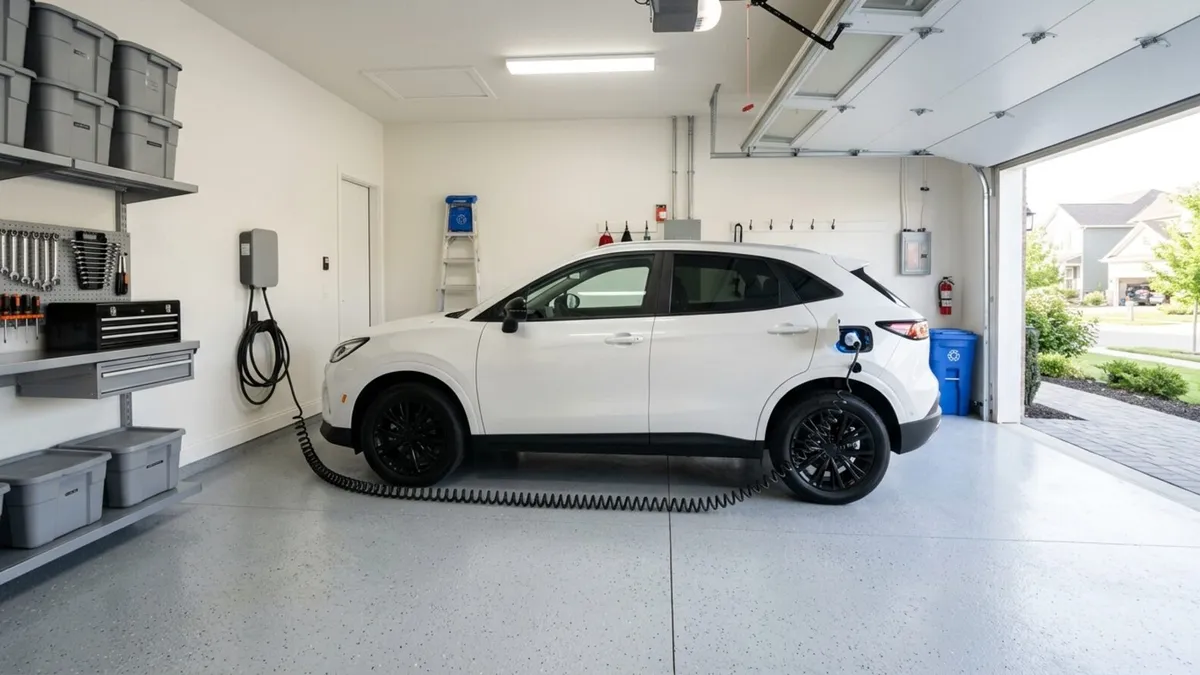
The Charging Cord That Came With Your Car
You bring home your first electric car, plug the included cord into the garage outlet, and wake up to find the battery only partly full. That’s Level 1 charging, and it’s the moment most drivers start asking whether they need something faster.
This guide compares Level 1 vs. Level 2 charging, explains why DC fast charging stays at public stations, and helps you decide if a home charger upgrade is worth it for your driving.
Level 1 vs. Level 2 Charging at a Glance
| Feature | Level 1 | Level 2 | DC Fast Charging |
|---|---|---|---|
| Power source | Standard 120 volt outlet | Dedicated 240 volt circuit | Commercial DC equipment |
| Typical range added | About 3 to 5 miles per hour | About 20 to 40 miles per hour | Most of a battery in under an hour |
| Where it’s used | Home, with the car’s included cord | Home, workplace, public lots | Highway corridors and public stations |
| Install needed | Usually none | Electrician, permit and inspection | Not practical for homes |
| Best for | Plug-in hybrids and short commutes | Most full electric drivers | Road trips |
Exact charging speeds depend on your vehicle’s onboard charger, the circuit size, battery temperature and how full the battery already is.
How Level 1 Charging Works
Level 1 uses the portable cord that comes with most EVs, plugged into a regular household outlet. It draws about as much power as a space heater, which is why it’s slow.
For a plug-in hybrid or a driver who covers 20 to 30 miles a day, Level 1 can keep up if the car sits plugged in overnight and on weekends. It has real limits, though:
- A long day of driving can take more than a full night to recover
- In cold Michigan weather, part of that small power supply goes to warming the battery, so less goes into range
- The outlet should be on its own circuit, because a shared garage circuit can trip when the freezer or a power tool runs
If you use Level 1, have the outlet checked. An older or worn receptacle can heat up under hours of continuous load.
How Level 2 Charging Works
A Level 2 charger connects to a dedicated 240 volt circuit, the same kind of circuit that runs an electric dryer or range. It can be a hardwired wall unit or a plug-in unit that uses a heavy-duty outlet.
Level 2 charging is several times faster than Level 1. For most drivers, that means plugging in when you get home and waking up to a full battery no matter how much you drove. It also makes timed charging practical, so you can charge during lower-cost overnight hours if your DTE rate plan rewards it.
Charger output depends on the circuit. Code treats EV charging as a continuous load, so a charger can only use 80 percent of the circuit’s rating. A 40 amp circuit supports a 32 amp charger, and a 60 amp circuit supports a 48 amp charger.
Why DC Fast Charging Isn’t for Homes
When people ask about fast or Level 2 charging at home, they’re often picturing the fast chargers at highway stops. Those are DC fast chargers, and they work differently.
Your car’s battery stores direct current (DC). Level 1 and Level 2 deliver alternating current (AC), and a charger built into the car converts it. DC fast chargers do that conversion in a large cabinet outside the car and push DC straight into the battery.
That equipment needs very large electrical service, usually three-phase commercial power that residential homes don’t have. The hardware is designed for public and fleet sites. For home use, Level 2 is the fastest practical option, and it’s more than enough for overnight charging.
Do I Need a Level 2 Charger?
A few questions help you decide.
You can probably stay with Level 1 if:
- You drive a plug-in hybrid with a small battery
- Your daily round trip is short and predictable
- The car sits parked for 12 hours or more most nights
A Level 2 charger makes sense if:
- You drive a full electric vehicle as your main car
- Your commute, errands or kids’ activities add up to a lot of miles
- You want a full battery every morning, even in January
- Two EVs share the garage, or a second one is coming
If you’re on the fence, try Level 1 through a few winter weeks. Cold mornings and short days show quickly whether it keeps up with your routine.
Plug-In vs. Hardwired Level 2 Chargers
Level 2 chargers come in two styles. A plug-in charger uses a 240 volt receptacle, often a NEMA 14-50, the same type used for some ranges and RVs. It’s easy to unplug and take with you if you move. The receptacle needs to be high quality, because hours of continuous charging put real stress on it.
A hardwired charger connects directly to the circuit with no plug in between. That removes a common point of wear, allows higher charging speeds on larger circuits, and works better for outdoor installs. For most homes that will keep the charger long term, hardwiring is usually the better choice. Either way, the charger must be set to match its breaker.
What a Level 2 Installation Involves
Every home is different, so we start with a look at your panel and the path to your parking spot. The main factors are:
- Panel capacity. We run a load calculation to confirm your service can handle the charger along with heat, cooling and cooking.
- Distance. A longer wire run from the panel to the garage or driveway means more material and labor.
- Charger type. Hardwired chargers and plug-in chargers each have their place. We’ll explain which fits your setup.
- Permit and inspection. A new 240 volt circuit needs an electrical permit. We handle it.
If your panel is full or your service is small, options include a load management device or a 200 amp service upgrade. For Tesla owners, we also install the Tesla Wall Connector.
Get Level 2 Charging Installed in Ann Arbor
Current Electrical Systems installs Level 2 chargers of all brands across Ann Arbor, Ypsilanti, Saline, Dexter and nearby communities. We’ve served Washtenaw County since 1994 with union electricians from IBEW Local 252. Learn more about our EV charger installation service, or read our EV charger troubleshooting guide if a charger you already own is acting up. There’s no scheduling fee to schedule a visit.