
What a Power Surge Does to Your Home
A power surge is a short spike in voltage, lasting a tiny fraction of a second. Big ones come from lightning hitting nearby power lines or from utility switching. Smaller ones happen every day inside your home when motors in the furnace, air conditioner, fridge or sump pump start and stop.
One large surge can knock out a circuit board in an instant. Repeated small surges wear electronics down over time, so things fail early without an obvious cause.
How a Whole House Surge Protector Works
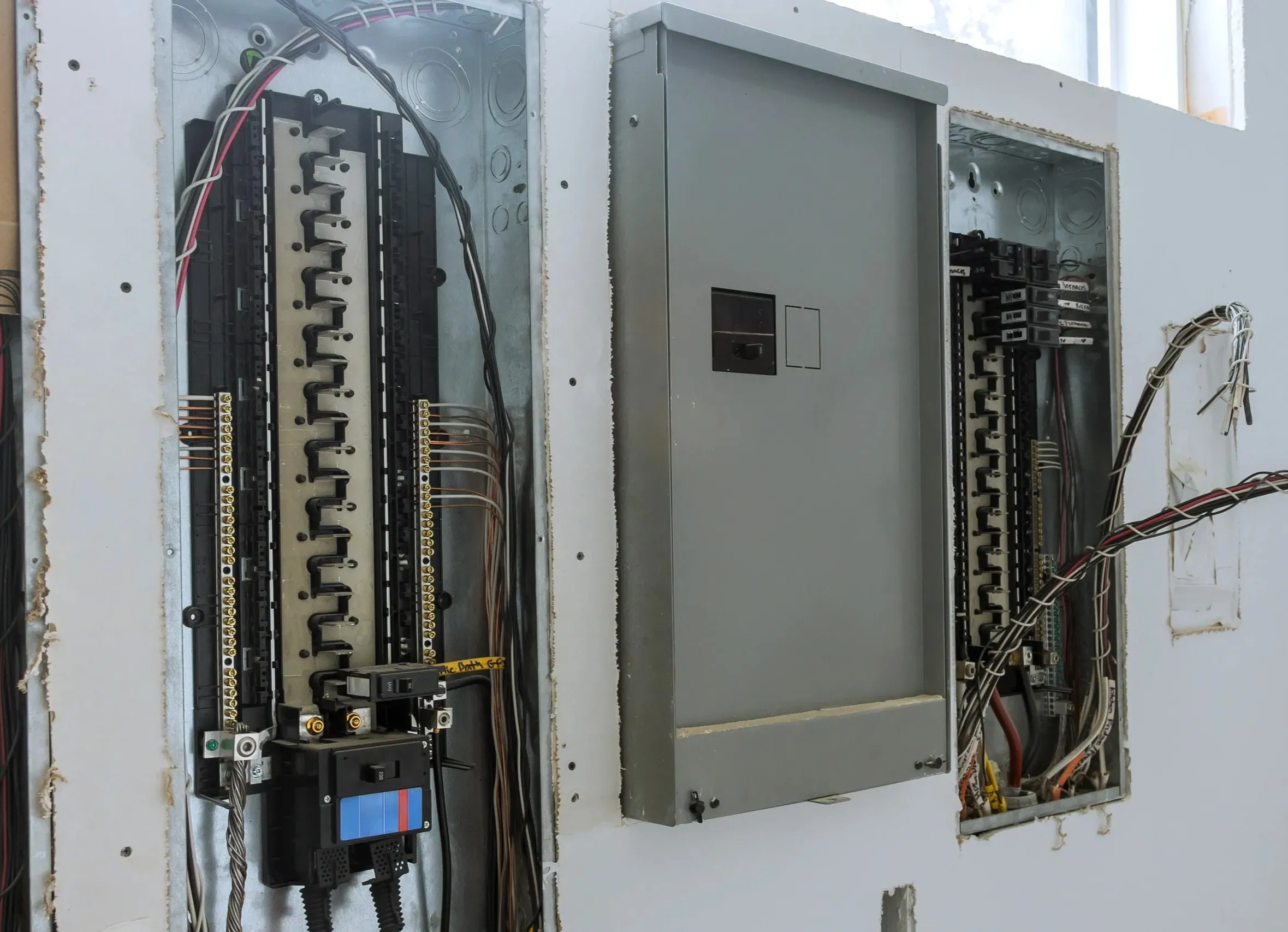
A whole house surge protector, also called a surge protective device or SPD, mounts at your electrical panel and connects to it through a dedicated breaker or directly to the service. It sits quietly until voltage spikes. When it does, the device diverts the extra energy to ground before it spreads through your circuits.
Because it protects at the panel, every circuit in the home gets a level of protection, including hardwired equipment you can’t plug into a power strip. Think of furnaces, air handlers, water heaters with electronic controls, ranges, dishwashers and EV chargers.
Type 1 vs. Type 2 Surge Protectors in Plain Terms
You’ll see surge protectors described by type. The difference is mostly about where they go:
- Type 1 installs ahead of your main breaker, on the utility side. It’s often mounted at or near the meter and handles surges coming in from the power lines.
- Type 2 installs after the main breaker, in or beside your electrical panel. It’s the most common whole house surge protector for homes.
- Type 3 is the point-of-use protection you already know, like a quality surge strip or outlet at the device.
We’ll look at your panel and service and recommend the setup that makes sense for your home.
Protecting HVAC, Appliances and EV Chargers
Modern homes have more electronics than most people realize. Almost every major appliance has a control board, and many of those boards are expensive or slow to replace.
A whole house surge protector is especially worth it if you have:
- A heat pump, high-efficiency furnace or central air conditioner
- Newer appliances with touch controls and displays
- An EV charger, which is a large investment on its own circuit
- A home office, networking gear or home theater
- A sump pump you rely on during storms
Point-of-Use Protection as a Second Layer
A panel-mounted surge protector handles the big spikes from outside. It won’t stop every small surge created inside the home. For computers, TVs, gaming consoles and networking equipment, we recommend quality surge strips or surge-protected outlets as a second layer.
Together, the two layers cover far more ground than either one alone. We’re happy to point out which outlets would benefit from point-of-use protection while we’re at your home.
Summer Storms in Southeast Michigan
Michigan summers bring plenty of thunderstorms, and lightning on nearby lines is a common source of large surges. Storms also bring outages, and power coming back on can cause spikes of its own.
If you’re adding a standby generator, surge protection at the panel is a smart companion. The same goes for anyone who has lost a furnace board or garage door opener after a storm.
Best Time to Add Surge Protection
A whole house surge protector can be added to most existing panels in a short visit. It’s an easy add-on when we’re already working in your panel, such as during an electrical panel replacement, a service upgrade or an EV charger installation.
If your panel is full or very old, we’ll check that it can accept a surge protector safely and explain your options.
What Affects the Cost of Surge Protection
A whole house surge protector is one of the smaller electrical projects we do, but a few things change the scope:
- Whether your panel has an open space for the surge protector’s breaker
- The age and brand of your panel
- Type 1 at the meter or Type 2 at the panel
- Whether we’re already working in the panel for another job
We’ll look at your setup and explain your options before any work begins.
Why Homeowners Choose Current Electrical Systems
We’ve been doing electrical work around Ann Arbor since 1994, and our electricians are union trained through IBEW Local 252. We’ll explain what a whole house surge protector can and can’t do, install it cleanly and show you how to check that it’s working. There’s no scheduling fee, and you pay only for the time we work.