
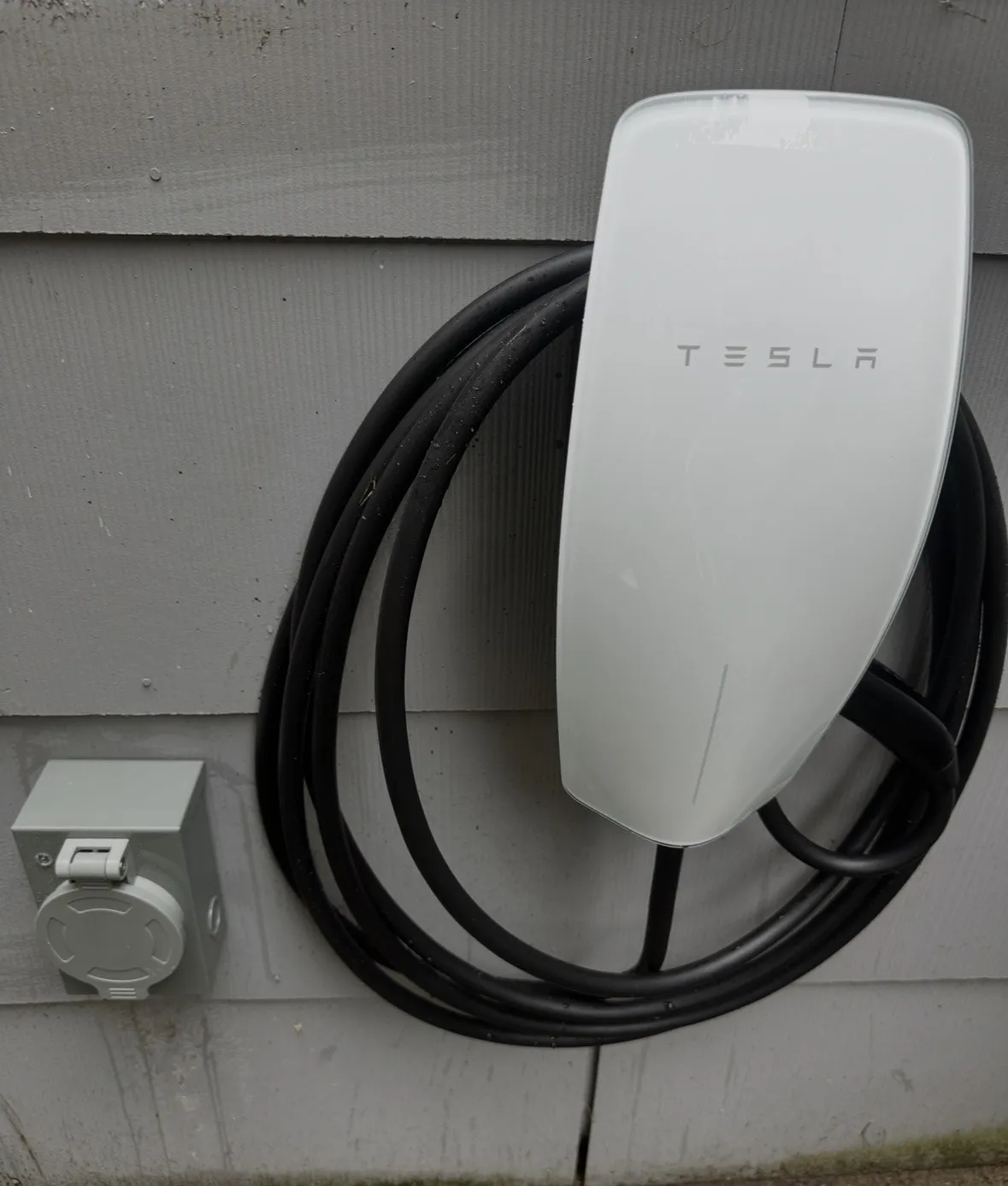
Why Home EV Charger Installation Makes Life Easier
Every electric car comes with a basic charging cord that plugs into a regular 120 volt outlet. That is Level 1 charging, and it is slow. For many drivers it adds only a few miles of range per hour, which is hard to keep up with if you commute to Detroit, drive the kids around Washtenaw County or head up north on weekends.
A Level 2 charger runs on 240 volts, the same kind of circuit a dryer uses. It charges several times faster, so most cars can refill a full day of driving overnight. You wake up to a charged car and rarely think about public chargers at all. Our guide on Level 1 vs. Level 2 EV charging walks through the difference in more detail.
Level 2 Charger Installation for Every Brand
We install Level 2 chargers for any electric vehicle and most major charger brands. Common choices we see in Ann Arbor garages include:
- Tesla Wall Connector, including the Universal Wall Connector for non-Tesla cars. See our Tesla Wall Connector installation page.
- ChargePoint Home Flex, which can be hardwired or plugged in
- Emporia, popular for its built-in load management options
- Wallbox, Grizzl-E and chargers sold by Ford, GM, Rivian and other automakers
If you have not bought a charger yet, we are happy to help you pick one that suits your car, your panel and how far you drive.
Hardwired vs. NEMA 14-50 Plug-In Chargers
There are two main ways to connect a home EV charger, and each has its place.
A hardwired charger connects directly to its circuit. It can charge at up to 48 amps on a 60 amp circuit, which is the fastest option for most homes. There is no outlet to loosen or wear out over years of daily use, and most outdoor installations are hardwired.
A plug-in charger uses a NEMA 14-50 outlet, the same style used for some ranges and RVs. It tops out at 40 amps of charging on a 50 amp circuit. The advantage is flexibility. You can unplug the charger and take it with you when you move. We install a heavy-duty, industrial-grade outlet and add ground-fault protection where current code requires it.
Garage vs. Outdoor Mount
Most of our Ann Arbor customers mount their charger in the garage, close to where the charging port lands when the car is parked. That keeps the cable out of snow and ice and makes the wire run from the panel shorter.
An outdoor mount makes sense for driveways, carports and homes without a garage. We use chargers rated for outdoor use, weatherproof fittings and conduit, and we think about where snow gets plowed and where the cable will hang in January. We also consider how the charger looks on the front of your house.
Load Management and Panel Capacity
A Level 2 charger is one of the biggest loads in a home, and it can run for hours at a time. Before any EV charger installation, we look at your panel and run a load calculation to make sure the house can handle it safely.
If capacity is tight, there are good options before a full upgrade:
- Lower the charger’s amperage. Many cars still fill up overnight on a 32 or 40 amp setting.
- Add load management. Some chargers and add-on devices watch your home’s total draw and slow charging when the dryer or oven is running.
- Use power sharing. Many brands let two chargers split the available power in a two-EV household.
If none of those work, a 200 amp service upgrade gives you room for the charger and whatever comes next.
Planning for a Second EV
Many Ann Arbor households that start with one electric car end up with two. If that is likely for you, tell us during the estimate. We can place the first charger where a second one fits nearby, choose a charger that supports power sharing and size the wiring with the future in mind. A little planning now can save you from a second long wire run later.
What Affects EV Charger Installation Cost
Every home is different, so we estimate each job after we see it. These are the factors that matter most:
- Distance and route from your electrical panel to the charger location
- Whether your panel has open space and enough capacity
- Indoor garage mount vs. outdoor mount
- Finished walls, ceilings or concrete that the wire has to pass
- Whether a load management device or service upgrade is needed
How EV Charger Installation Works With Us
- Walkthrough. We look at your panel, your parking spot and your charger, then give you an honest estimate of the time and materials involved.
- Permit. We pull the electrical permit with your city or township.
- Installation. Our electricians run the dedicated circuit, mount the charger and set its amperage to match the breaker.
- Testing and inspection. We test the charger with your car when possible, meet the inspector and show you how everything works.
Many chargers can schedule charging for overnight hours, which pairs well with a time-of-use rate from DTE. If your charger ever stops working, our EV charger troubleshooting guide covers the common fixes.
Why Ann Arbor Drivers Call Current Electrical Systems
We have been wiring homes around Ann Arbor since 1994, and our electricians are union trained through IBEW Local 252. We install chargers for every brand, explain your options in plain terms and leave a clean, tidy installation you will be proud to show off. Call (734) 210-7667 to schedule your electric car charger installation.