
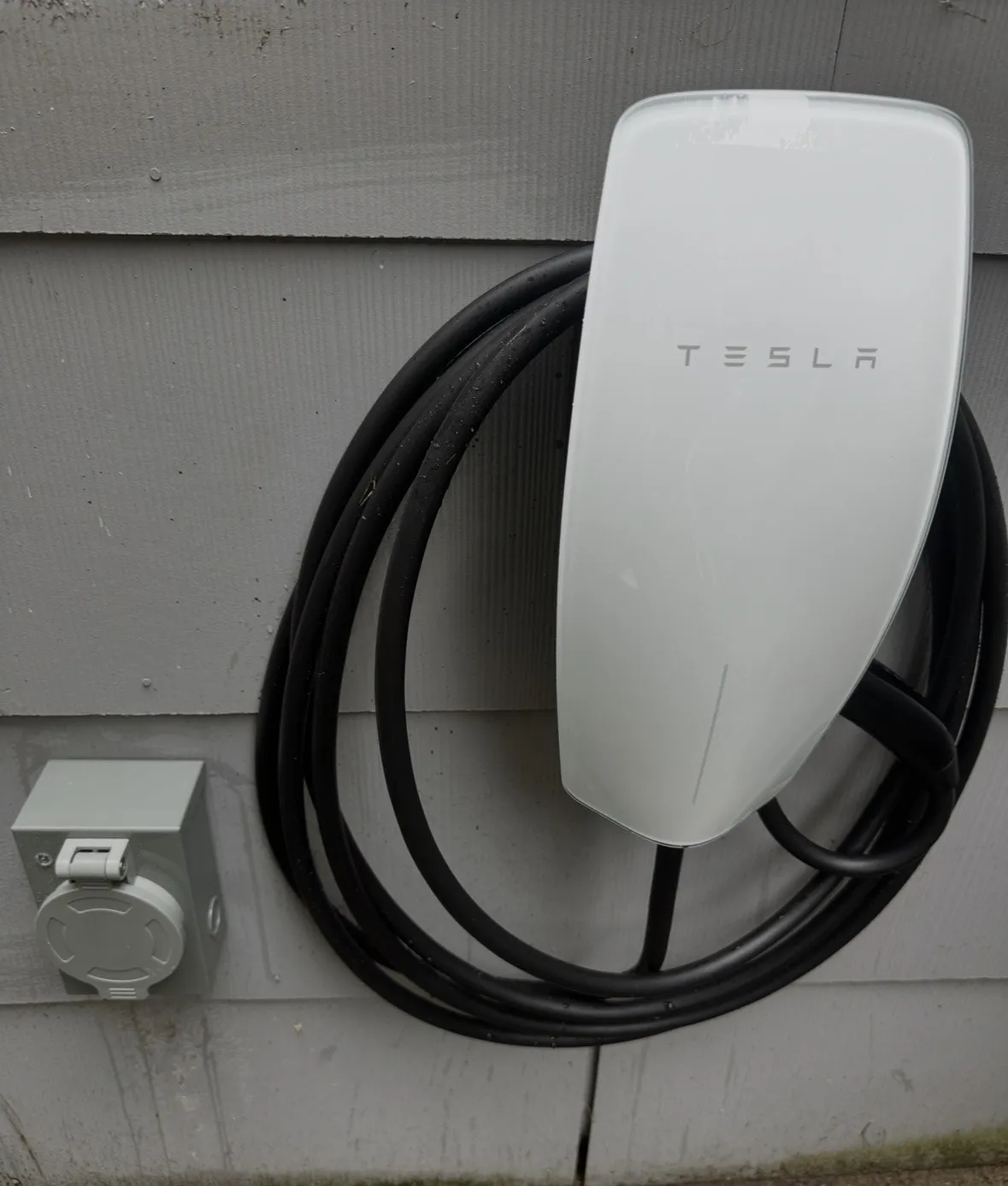
Why Tesla Owners Upgrade to a Wall Connector
Most Tesla owners start with the Mobile Connector. It works, but on a regular 120 volt outlet it adds only a few miles of range per hour. Even on a 240 volt outlet it is capped at 32 amps.
A Tesla Wall Connector is a hardwired Level 2 charger built for daily use. It can charge at up to 48 amps, it stays mounted on the wall with a long cable, and it updates its own software over Wi-Fi. You come home, plug in and wake up to a full battery without thinking about it.
It also frees up the Mobile Connector to live in the trunk for road trips, which is where most owners end up keeping it.
Gen 3 Wall Connector and Universal Wall Connector
Tesla sells two home chargers, and we install both.
The Gen 3 Wall Connector has the Tesla-style connector (called NACS) and is the standard choice for households with Tesla vehicles. It is rated for indoor and outdoor installation, so it works in a garage or on the side of the house.
The Universal Wall Connector adds a built-in adapter so it can charge cars with either a NACS port or the J1772 port found on many other EVs. If you have a Tesla and a non-Tesla EV, or you expect your next car to be a different brand, the Universal Wall Connector covers both without a separate adapter.
Circuit Sizing: The 60 Amp Breaker for 48 Amp Charging
EV charging is treated as a continuous load in the electrical code. That means the circuit has to be sized at 125 percent of the charging current. For a Gen 3 Tesla Wall Connector charging at its full 48 amps, that works out to a 60 amp breaker with wire sized to match.
The Wall Connector can also be installed on a smaller circuit. During setup, the charger is set to the breaker size, and it limits its own output to stay within that circuit. Common settings look like this:
- 60 amp breaker allows up to 48 amps of charging
- 50 amp breaker allows up to 40 amps of charging
- 40 amp breaker allows up to 32 amps of charging
Your car’s onboard charger also sets a limit, so the biggest circuit is not always the best choice. We look at your vehicle, your driving and your panel before recommending a size.
Checking Your Panel Before the Install
A 60 amp charging circuit is a big addition to any home. Before Tesla charger installation, we run a load calculation to confirm your service can handle it alongside your furnace, air conditioner, dryer and range.
Many homes with 200 amp service have plenty of room. Homes with 100 amp service may still work with a smaller circuit setting. If your house is already near its limit, we will talk through a 200 amp service upgrade or other options on our main EV charger installation page.
Power Sharing for Two Wall Connectors
Two-Tesla households do not always need two full-size circuits. Gen 3 Wall Connectors support power sharing, which links multiple units so they split the available power from a single circuit.
When both cars are plugged in, the chargers divide the power between them. When one car is full, the other gets everything. Overnight, both cars are usually ready by morning. We handle the wiring, link the units during setup and confirm they are communicating before we leave.
Garage and Outdoor Wall Connector Placement
Placement matters more than people expect. We look at where your charge port sits when you park, whether you back in or pull in, and where a second car might go later. A few feet in the right direction can keep the cable off the floor and out of the way.
For outdoor mounts, we use weatherproof fittings and conduit and think about snow, plow paths and how the charger looks on the house.
How Tesla Wall Connector Installation Works
- Walkthrough. We look at your panel, parking spot and charger model, then give you an honest estimate of the time and materials involved.
- Permit. We pull the electrical permit for the new circuit.
- Installation. Our electricians run the circuit, mount the Wall Connector and land the wiring neatly.
- Commissioning. We set the breaker size, configure power sharing if needed and help connect the charger to your Wi-Fi.
- Inspection. We meet the inspector and confirm the charger works with your car.
If something ever acts up after installation, our EV charger troubleshooting guide covers the common issues, and we are reachable Monday through Friday if you need us.
Scheduling Charging Around Your DTE Rate
Your Tesla app lets you set a charging schedule, so the car can wait until overnight hours to start. If you are on a time-of-use rate plan from DTE, that simple setting can shift most of your charging to lower-cost hours. We are glad to show you where the setting lives when we finish the installation.
Protect the Charger With Surge Protection
Wall Connectors and the cars they charge are full of sensitive electronics. A whole-house surge protector at your panel is a simple add-on that helps protect the charger, your car’s charging system and the rest of your home from voltage spikes.
A Local Electrician for Your Tesla Charger Installation
Current Electrical Systems has served Ann Arbor, Saline, Dexter and the surrounding communities since 1994. Our electricians are union trained through IBEW Local 252. We install Tesla Wall Connectors with the same care we bring to every job, with tidy wiring and a clear explanation of how everything works. Call (734) 210-7667 to schedule a visit.