
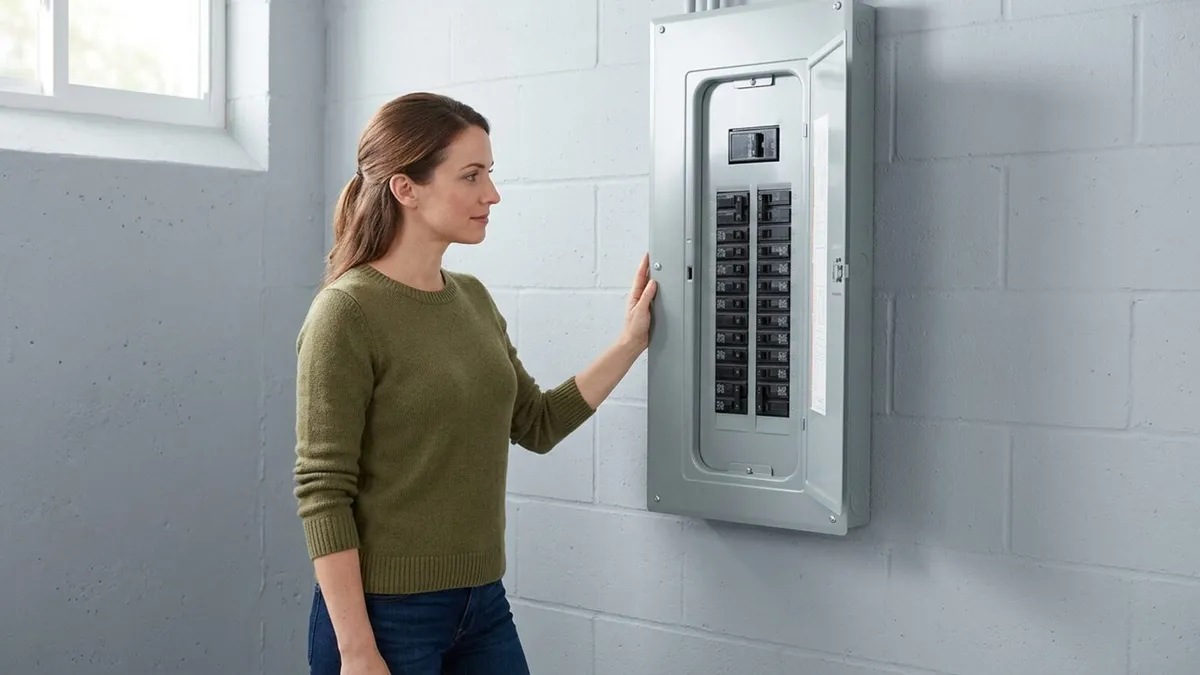
The Box You Only Visit When the Power Goes Out
Most people open the electrical panel for the first time when the kitchen outlets die halfway through making dinner. You flip the door open, look at two rows of switches with faded labels, and wonder which one to touch.
Understanding your electrical panel takes about ten minutes, and it pays off every time a breaker trips. This guide shows you how to read a breaker box, what the numbers mean and which signs mean it’s time to call an electrician.
What an Electrical Panel Does
Power from DTE travels through the meter outside your house and into the electrical panel, also called a breaker box or service panel. The panel splits that power into individual circuits, each protected by its own breaker.
A breaker is a switch that turns itself off when a circuit draws more current than its wire can safely carry, or when it senses a short. That automatic shutoff is called a trip. It protects the wiring in your walls from overheating.
How to Read a Breaker Box
Open the outer door and you’ll see a few key parts:
- The main breaker. The large breaker at the top, or sometimes at the side, controls power to the whole panel
- Branch breakers. The rows of smaller breakers below, each feeding one circuit in the house
- The panel directory. The label card inside the door that should say which rooms or appliances each breaker controls
- The rating label. A sticker inside the door that lists the panel’s maximum amperage and the breaker types it accepts
Breakers are usually numbered down the left side with odd numbers and down the right side with even numbers. The directory matches those numbers. If your directory is blank or reads “misc” and “spare” all the way down, it’s worth mapping your circuits on a Saturday with a helper and a lamp.
The Main Breaker Explained
The main breaker is the master switch. Turning it off cuts power to every branch circuit in the panel at once. Its number, often 100, 150 or 200, tells you your home’s service size in amps.
Two things to know. First, the main breaker does not de-energize the heavy service wires that come into the panel from the meter. Those stay live. Second, in some homes the main disconnect lives in a separate box outside by the meter, and the indoor panel has no main breaker of its own.
What Do the Numbers on a Breaker Mean?
The number stamped on each breaker handle is its amp rating. Typical ratings in a home include:
- 15 amps for general lighting and bedroom outlets
- 20 amps for kitchen countertop outlets, bathrooms, laundry and garages
- 30 amps for an electric dryer or water heater
- 40 to 50 amps for an electric range, hot tub or Level 2 EV charger
- 60 amps and up for large heat pumps, subpanels or high-output chargers
The rating is matched to the size of the wire on that circuit. A 20 amp breaker on wire meant for 15 amps would let the wire overheat before the breaker trips. That’s why “just put in a bigger breaker” is never the fix for a breaker that trips often.
Single Pole vs. Double Pole Breakers
A single pole breaker takes one space and supplies 120 volts. It powers lights, outlets and small appliances.
A double pole breaker takes two spaces side by side, with the handles tied together, and supplies 240 volts. Larger appliances need it. Your dryer, range, water heater, central air conditioner and any EV charger most likely run on double pole breakers. If one side trips, the tie bar shuts off both.
Special Breakers You May See
Newer panels include breakers with a small test button on the face:
- GFCI breakers (ground fault circuit interrupter) trip when current leaks to ground, like through water or a person. Code calls for them in bathrooms, kitchens, garages, basements and outdoors.
- AFCI breakers (arc fault circuit interrupter) trip when they detect sparking in damaged or loose wiring, a common cause of house fires. They are required on many living area circuits in new work.
- Dual function breakers combine both types.
Pressing the test button once a month or so confirms the breaker still trips when it should.
Resetting a Tripped Breaker Safely
A tripped breaker usually sits in the middle position. To reset it, push the handle firmly to off, then back to on. If it trips again right away, leave it off. Unplug what’s on that circuit and try once more. A second immediate trip means there’s a fault, and it’s time to call us.
Never hold a breaker in the on position or tape it there. If the same breaker trips every few days, the circuit is overloaded or failing, and our electrical repair team can find out why.
What If You Have a Fuse Box?
Some older homes still have a fuse box instead of breakers. Fuses do the same job, but a blown fuse has to be replaced instead of reset. Always replace a fuse with the same amp rating printed on the old one. A larger fuse removes the protection the wire depends on.
Fuse boxes often go along with 60 amp service, which leaves little room for modern appliances. They also make it tempting to oversize fuses when one keeps blowing. If your home still runs on fuses, replacing the box with a modern breaker panel is one of the most useful safety upgrades you can make.
Signs Your Panel Needs an Electrician
Opening the door and resetting breakers is homeowner territory. The inner cover, called the dead front, should only come off for a licensed electrician. Call us if you notice:
- A panel door or breaker that feels warm to the touch
- Buzzing, crackling or a burning smell
- Rust, water stains or scorch marks
- Breakers that won’t stay on or won’t reset
- A Federal Pacific (Stab-Lok) or Zinsco panel, both known for breakers that may fail to trip
- No open spaces left, or many doubled-up tandem breakers
Older brands are worth replacing even if they seem fine. Our page on Federal Pacific and Zinsco replacement explains why. If you’re planning a heat pump, EV charger or addition on 100 amp service, a 200 amp service upgrade may be the right next step.
Panel Help From Current Electrical Systems
We’ve been working in electrical panels around Ann Arbor since 1994, and our electricians are union trained through IBEW Local 252. For a panel check, a mapped directory or a full electrical panel upgrade, we start with a visit and a clear explanation of what we found.