
The Ice Storm Plan That Needs One More Piece
The branches are coming down, the street has gone dark and the portable generator you bought last year is finally out of the garage. Then comes the hard part. A pile of extension cords reaches the refrigerator and a lamp, but not the furnace, the sump pump or the well.
Generator interlock vs transfer switch is the choice most portable generator owners face next. Both connect your generator to the house wiring safely. They work differently, and one usually suits your home better.
What a Generator Interlock Kit Does
An interlock kit is a simple mechanical plate that mounts on the front of your breaker box. It sits between the main breaker and a dedicated generator breaker, and it blocks one whenever the other is on.
To switch over, you turn the main breaker off, slide the plate and turn the generator breaker on. You cannot have both on at once, so the generator can never feed power back out to DTE’s lines.
Your whole panel stays usable. You decide which circuits to run by flipping individual breakers, and you can change your mind in the middle of an outage.
For the details on the equipment we install, see our generator interlock kit installation page.
What a Transfer Switch Does
A manual transfer switch is a small separate box wired beside your main panel. A handful of circuits you picked during installation, often the furnace, refrigerator, sump pump and some lights, are moved onto it. A switch on the front chooses utility power or generator power.
It is easy to use, and the labeled switches take the guesswork out of the switchover. The tradeoff is that you can only power the circuits that were moved over. Adding another one later means more wiring and a return visit.
An automatic transfer switch is a different animal. It is part of a whole-home standby generator and moves the house onto generator power by itself, with no one standing outside in the snow.
Generator Interlock vs Transfer Switch, Side by Side
For a portable generator, the two stack up like this:
- Circuits you can run. An interlock gives you every circuit in the panel. A transfer switch gives you the group chosen at installation.
- Ease of use. A transfer switch is a little simpler on a stressful night. An interlock takes a short routine you can practice once on a calm weekend.
- Installation. An interlock uses the panel you already have and usually takes less material and time. A transfer switch needs its own box and extra wiring.
- Panel fit. An interlock must be listed for your panel’s brand and model. Some older panels have no kit, and a transfer switch may be the answer.
- Cost. Both depend on your panel, the wire run and the permit. We can only quote after seeing the job, so we give free estimates.
For most portable generator owners, we lean toward the interlock because it is flexible and easy to understand. The right answer still comes from your panel and your priorities.
The Generator Inlet Box and the Cord
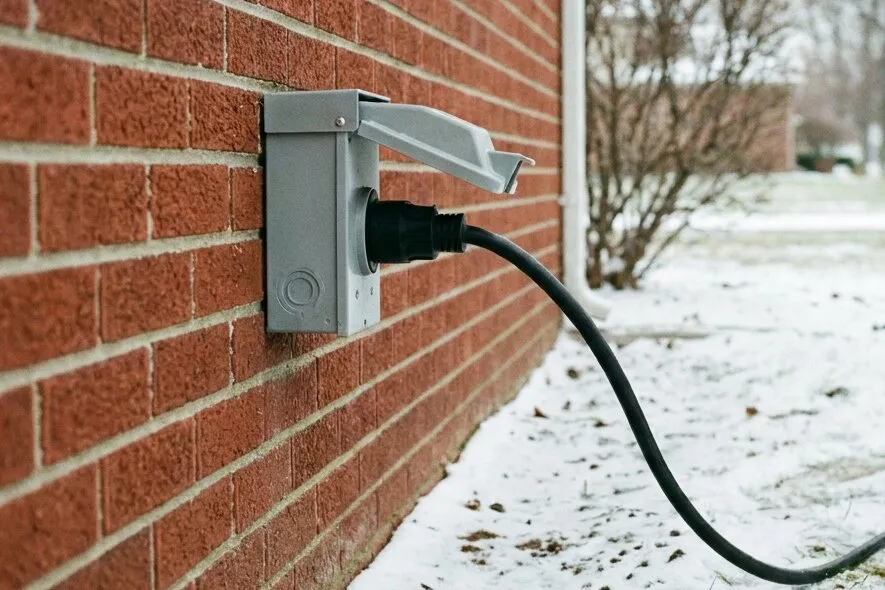
Whichever you choose, the generator should not plug into a wall outlet. It plugs into a generator inlet box, a weatherproof connector mounted on the outside wall of the house. The inlet is wired back to the panel, so there is a safe, fixed path for the power.
The inlet connector has recessed pins. Nothing live is exposed, and the cord only becomes live when the generator runs and you’ve made the switchover.
We place the inlet where you can reach it through snow and close to where the generator will sit. It needs to match your generator’s outlet, so tell us the make and model of your unit. Planning the inlet and the generator spot together also makes it easier to keep exhaust away from the house.
Why Backfeeding Is the Danger
Some people try to skip all of this with a male-to-male cord, plugging the generator into a dryer outlet. That is called backfeeding, and it is dangerous. Power travels backward through your house wiring and onto the utility lines, where it can seriously injure or kill a line worker restoring service.
It also leaves live prongs exposed on the cord, and it can damage the generator when DTE’s power comes back. An interlock or transfer switch makes that kind of mistake physically impossible.
This is the main reason we do not encourage a do-it-yourself hookup. The interlock must be listed for your panel, the generator breaker has to be secured properly and the work needs an electrical permit and inspection. We handle all of it.
Carbon Monoxide Rules Do Not Change
A safe electrical hookup does not make the generator itself safe to run anywhere. The Consumer Product Safety Commission says to operate portable generators outside only, at least 20 feet from the house, never in a garage, basement, crawlspace or shed.
The same page points out that opening doors or windows will not clear enough exhaust to prevent lethal carbon monoxide levels. Keep battery-powered CO alarms working on every floor, and keep the generator maintained. Our generator maintenance guide for Michigan has a seasonal checklist.
When a Standby Generator Makes More Sense
A portable generator with an interlock is a smart, affordable fit for many Ann Arbor homes. It does ask something of you. Someone has to roll it out, fuel it, start it and run the switchover, sometimes in the dark and in the cold.
If you travel often, have a family member who relies on medical equipment or simply want the lights to come back by themselves, a standby generator is worth pricing. We install Generac and Honeywell standby generators with transfer switches, and we handle the permits and inspections. Our generator services page covers both paths.
Getting It Installed in Washtenaw County
Current Electrical Systems has served Ann Arbor, Saline, Dexter, Brighton and the surrounding area since 1994, and our electricians are union trained through IBEW Local 252. We look at your panel, explain which option fits and take care of the permit and inspection.
If a storm has already damaged your service mast or meter base, our storm damage electrical repair call-outs come first. When things are calm again, contact us for a free estimate on your hookup.