
Why Every Old House Gets a Different Estimate
A neighbor tells you her knob and tube rewire cost one amount, and your cousin in Ypsilanti says his cost something else. Both can be true. The wiring in a hundred-year-old house was added to, patched and half replaced by several owners, so no two jobs start from the same place.
That is why knob and tube wiring replacement cost can’t be quoted from a phone call or a square-foot rule. It comes down to what is in your walls, how we reach it and what the rest of the electrical system needs. Those are the things we can walk you through.
What a Knob and Tube Replacement Involves
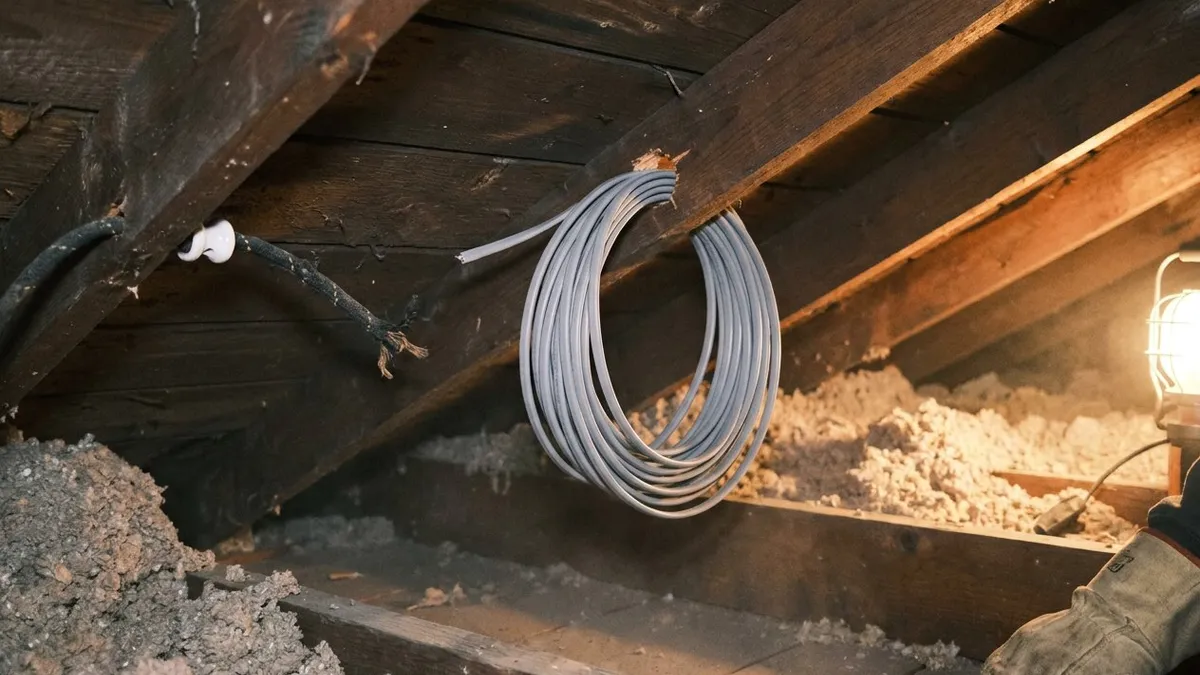
Knob and tube wiring is the old system of separate wires held off the framing by porcelain knobs and threaded through joists in porcelain tubes. Our knob and tube replacement page covers how to spot it. Once you’ve decided to replace it, the work goes in stages.
- Free walkthrough. We look at the basement, attic and panel, and we test circuits to learn which runs are live.
- Circuit plan. We lay out new grounded circuits for the kitchen, bathrooms, bedrooms and everything you plug in today.
- Fishing new cable. We pull modern cable through wall and ceiling cavities, working from the attic and basement.
- Small openings. We cut into a wall only where a run cannot be reached any other way.
- Disconnecting the old system. Every old run is disconnected from power. Exposed sections in the attic and basement come out, and sections sealed in walls are left dead.
- Permit and inspection. We coordinate the permit and the inspection, and many homes need a panel at the same time.
What Makes a Knob and Tube Job Bigger or Smaller
Most of the price comes from labor, so the question is how many hours it takes to get new circuits to every room safely. These details move that number the most:
- Size of the house. More rooms and more floors mean more circuits to plan and more cable to pull.
- How much is still live. A house with half its wiring already updated is a smaller job than one where every room still runs on the original.
- Access. An open attic and an unfinished basement let us work from above and below. Finished ceilings, knee walls and closed-in cavities add time.
- Wall and ceiling construction. Plaster and lath behave differently from drywall, and some framing makes a clean path for new cable and some doesn’t.
- The panel. If the house still has a fuse box or an undersized panel, replacing it becomes part of the plan.
- Added circuits. A new kitchen outlet layout, a bathroom fan or a dedicated line for an appliance adds to the scope.
We look for each of these at the walkthrough and explain how it affects your house. Older Ann Arbor neighborhoods with plaster walls and finished attics tend to take more planning than a house with an open attic and a bare basement, and we’d rather you hear that before the work starts.
How Our Approach Keeps Wall Repair Down
Wall and plaster repair can end up as a second bill that people forget to budget for. We plan every new run before we open anything, reach as much as we can from the attic and basement, and make only the openings we truly need.
Fewer openings means less patching, less painting and fewer days of a disrupted home. It also helps the overall cost, since the repair work after a rewire is often a large share of the total. If you’re also planning a remodel, we can coordinate the rewiring with that work so walls only get opened once.
Why We Replace Live Runs Instead of Patching Them
It’s tempting to ask whether new cable can simply be connected to the old runs. That approach keeps old wire in the circuit. The insulation is brittle, there’s no ground wire, and nobody knows what past owners spliced in behind the plaster.
A patched circuit also leaves the biggest hazard in place. Knob and tube wiring was built to shed heat into open air, so insulation packed around a live run can cause it to overheat. We recommend replacing every run that is still in use, then adding insulation if you want it.
If you only have a few live circuits left, the project can be smaller than you’d guess. We tell you exactly which ones they are.
Panels, Permits and Other Costs Homeowners Forget
Homes with knob and tube wiring often have a fuse box or a small breaker panel. Modern circuits need room, and a 200 amp service upgrade is a common companion project, with DTE disconnect and reconnect coordinated for you. Doing the panel and the wiring together saves bringing crews back later.
Permit and inspection are part of the project too. And if the reason you’re replacing is an insurer or a buyer’s inspector, our post on knob and tube wiring and home insurance in Michigan explains what to ask your agent and what paperwork helps.
How We Price Knob and Tube Rewiring in Ann Arbor
Most of our work is billed on time and materials, and there is no scheduling fee. You pay for the time worked and the materials used, rather than a flat number padded to cover surprises inside the walls. Our pricing page explains how that works.
For a rewire, we visit first, look at the house and give you an honest estimate of the time and materials involved. Walkthroughs are free. To set one up for your house in Ann Arbor, Saline, Dexter or anywhere in Washtenaw and Livingston counties, contact us.