
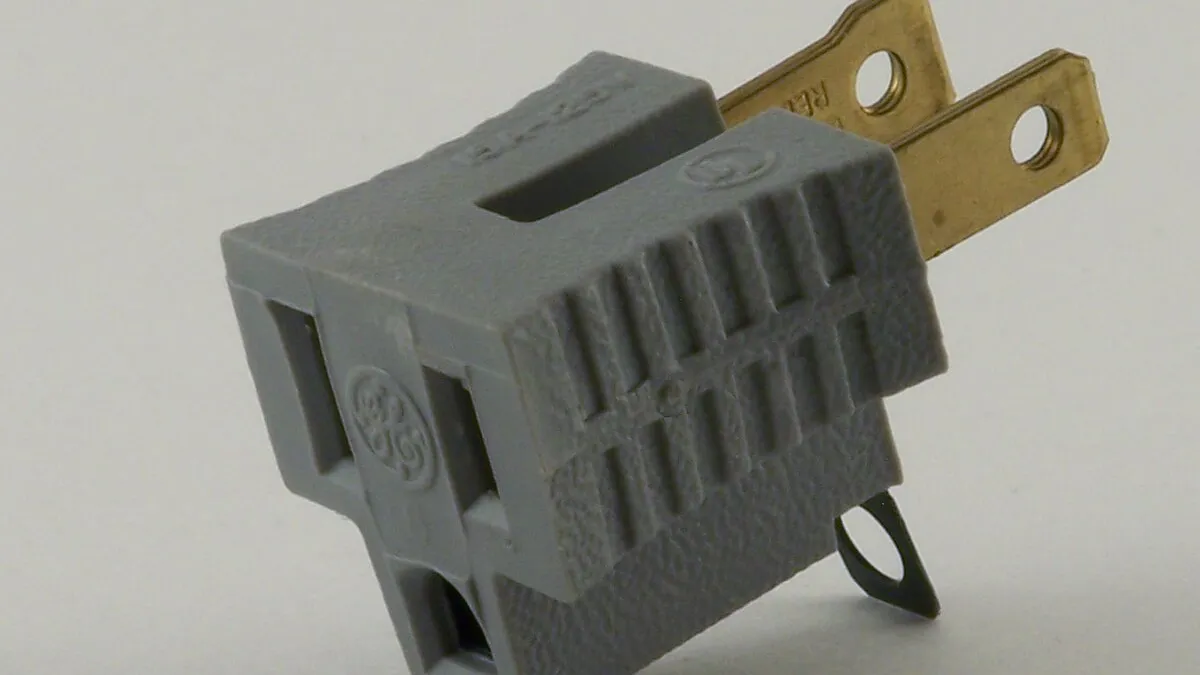
Photo: PleaseStand, CC BY 3.0, via Wikimedia Commons
The Outlet That Will Not Take Your Plug
You move into an older house, plug in a surge protector for your computer and the plug will not fit. The outlet has two slots and no round hole, and the adapter from the hardware store is sitting in a kitchen drawer.
Two prong outlets are common in Ann Arbor homes built before grounded wiring became standard. They still work, but they leave you with real choices, and a few of the popular fixes do not do what people think.
What Two Prong Outlets Tell You About the Wiring
A modern outlet has three openings: hot, neutral and ground. A two prong outlet has only the first two. It means the circuit has no equipment grounding conductor, which is the path that carries stray current back to the panel if something goes wrong.
Older houses were wired this way on purpose. Knob and tube wiring has no ground wire, and early cable from the same era often did not have one either. If you have two prong outlets, you may also have wiring that deserves a closer look.
Are Ungrounded Outlets Safe to Use?
Ungrounded outlets are not an emergency, and a lot of lamps and phone chargers run fine on them. The concern is what they cannot do.
An appliance with a metal case, such as a refrigerator or a power tool, relies on a ground to carry a fault away from you. A surge protector uses a ground connection to divert a surge. Without one, those devices lose part of their protection.
That does not mean you have to panic. It means ungrounded outlets are worth updating, and worth planning around if you buy electronics or appliances.
Why a Cheater Plug Is Not a Fix
A cheater plug, also called a three-to-two adapter, lets a three-prong plug fit a two-slot outlet. The small metal tab on it is meant to attach to the cover plate screw.
The problem is that a two-wire circuit has no ground for that tab to reach. The adapter makes the plug fit while the ground stays missing. It can also give a false sense of safety, since the plug looks grounded.
If you need an adapter for a lamp that has a two-prong plug anyway, that is fine. We steer people away from using them for anything that is supposed to be grounded.
Three Code-Approved Ways to Replace a Two Prong Outlet
The National Electrical Code covers this in section 406.4(D)(2), as summarized by EC&M magazine. A non-grounding outlet can be replaced with one of three things.
- Another two prong outlet. The simplest option, and it keeps things as they were.
- A GFCI outlet. It must be labeled No Equipment Ground, and it adds shock protection even without a ground.
- A grounded outlet fed by a GFCI. The downstream outlets are marked GFCI Protected and No Equipment Ground, and no ground wire is connected to them.
A plain three prong outlet on an ungrounded circuit is not on that list. That is the swap people most often try on their own.
Which Option Fits Your House
The right choice depends on what is in the walls and how you use each room.
GFCI protection is a strong, affordable step for kitchens, bathrooms, basements and garages, where moisture adds risk. In a bedroom or living room with a few lamps, a two prong replacement may be enough.
For rooms where you run computers, a home office or a workshop, the better answer is a real ground. Our outlet and circuit installation work includes new grounded circuits where walls allow.
Rewiring for a Real Ground
The only way to get a true ground is to run new cable with a ground wire to the outlet. Sometimes an existing circuit can be updated by pulling a new cable through the same path. Other times we open a small section of wall or work from the attic or basement.
When many outlets in a house are ungrounded, a partial or full rewire can be more sensible than patching circuit by circuit. We walk through the house, tell you which circuits are the biggest concern and let you decide how much to do at once.
Two Prong Outlets, Home Inspections and Insurance
If you are buying an older home, a home inspection report will usually mention ungrounded outlets. It is a common line item and rarely a reason to walk away.
What buyers and insurers often want is an electrician’s read on the whole picture. An electrical inspection looks at the panel, the wiring type and the outlets. Our guide to knob and tube wiring insurance in Michigan covers what to ask your agent when the old wiring is involved.
Permits for Outlet and Wiring Work
Replacing a single outlet is minor work. Adding circuits or rewiring is a different matter.
Michigan’s Bureau of Construction Codes requires a permit before wiring is added or altered, and the City of Ann Arbor issues electrical permits through its building department. We pull the permit and meet the inspector, so that part is handled.
Updating Two Prong Outlets in Ann Arbor Homes
We test a few outlets, find out what is behind them and tell you which of the three options makes sense for each room.
Our union electricians (IBEW Local 252) have worked in Ann Arbor since 1994. Contact us for a free estimate. Our pricing is time and material, with no scheduling fee.