
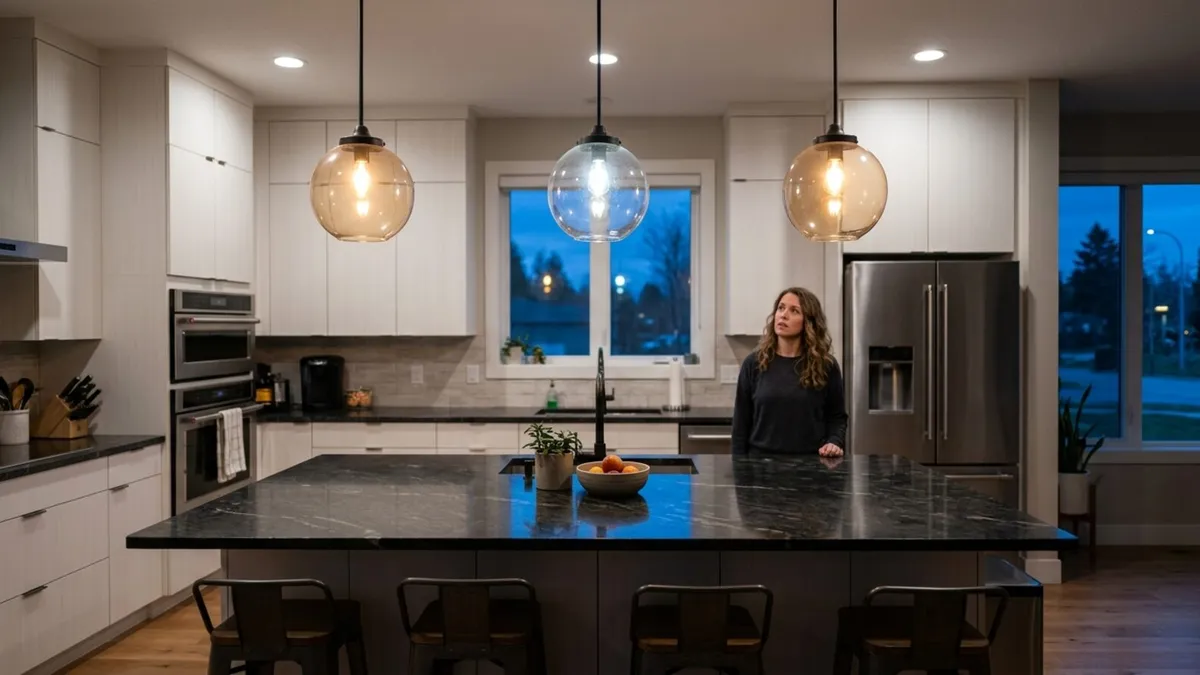
The Flicker You Can’t Ignore
You’re making dinner and the pendant over the island blinks. A few minutes later it does it again. Or maybe every light in the house dips when the air conditioner starts. Flickering lights are easy to shrug off, but they are one of the clearest messages your electrical system can send.
So why are my lights flickering? The answer depends on how far the flicker spreads. This guide sorts the causes into one fixture, one circuit and the whole house, and it covers the red flags that mean you should act today.
Figure Out How Far the Flicker Spreads
Before you change anything, spend a few minutes watching:
- One light only. The problem is most likely the bulb, the fixture or its switch.
- Several lights in one area. Lights and outlets on the same circuit point to a connection somewhere along that circuit.
- Lights all over the house. The cause is likely in the panel, the service entrance or the utility’s equipment.
Also notice timing. Does it happen when a specific appliance starts, at certain times of day, or on windy days? Those details help us find the cause faster.
When One Light Flickers
A single flickering fixture is the most common and usually the simplest case. Work through these checks with the switch off:
- Tighten the bulb. A bulb that isn’t fully seated makes an unsteady connection.
- Swap the bulb. Try a new bulb, ideally one you know works in another fixture.
- Check the dimmer. Many LED bulbs flicker on older dimmers that were built for incandescent bulbs. Look for a dimmer rated for LED, and check that the bulb itself says dimmable.
- Try the switch. If jiggling the switch makes the light flicker, the switch is worn or has a loose wire.
If a new bulb and a compatible dimmer don’t fix it, the socket or fixture wiring may be worn. Our smart lighting troubleshooting guide covers extra causes if the fixture uses smart bulbs.
When One Circuit Flickers
When several lights in the same rooms flicker together, the problem is likely a loose connection somewhere on that circuit. Common spots include:
- Outlets wired with backstabbed connections, where wires push into holes on the back instead of wrapping around screws
- Wire splices in a junction box or ceiling box that have loosened over time
- A loose terminal at the breaker in the panel
- An overloaded circuit, where a space heater or window unit makes the lights dim
Loose connections create heat. This is not a job to open up yourself. Our electrical repair team traces the circuit and fixes the weak point. In older homes, flicker across many circuits can also be a sign that it’s time to consider rewiring.
When the Whole House Flickers
Whole house lights flickering deserves quick attention. The cause is usually in one of two places.
On the utility side. DTE owns the transformer, the service wires to your house and the meter. Storms, wind moving overhead lines, a failing transformer or heavy loads shared by neighbors can all cause flicker. If neighbors see it too, or the service drop to your house looks damaged, call DTE Energy.
On the home side. You own the meter base, the service entrance wires and your panel. A loose connection at the main lugs or a deteriorating service neutral can cause lights to flicker, dim in some rooms and brighten in others. A loose neutral is a serious problem that can damage appliances and electronics.
If you’re not sure which side it’s on, call us first. We check your panel and service connections and coordinate with DTE when the problem sits on their side.
Why Lights Flicker When the AC Turns On
Air conditioners, heat pumps, well pumps and sump pumps all use motors. When a motor starts, it pulls a short burst of current, called inrush current, and lights on the same service can dip for a split second.
A brief, faint dim can be normal. It’s worth a call if:
- The dim is deep or lasts more than a moment
- It’s getting worse over time
- The lights flicker the whole time the AC runs, not just at startup
- Breakers trip when the unit kicks on
These signs can point to a loose connection, a service that’s undersized for today’s loads, or a failing start capacitor in the air conditioner. In some cases, a panel upgrade or 200 amp service upgrade solves the problem for good.
Safety Red Flags
Turn off the affected circuit and call an electrician promptly if flickering comes with any of these:
- A burning smell or smoke
- Switch plates, outlets or the panel feel warm to the touch
- Buzzing, crackling or sizzling sounds
- Scorch marks on outlets or switches
- Some lights get brighter than normal while others dim
- A breaker that trips often, or a panel that’s older, such as Federal Pacific or Zinsco
Bulbs brightening beyond normal is a classic sign of a lost neutral. It can damage electronics quickly, so don’t wait on it.
Flickering Lights in Older Homes
Many houses around Ann Arbor have wiring that has been added to over several decades. Each generation of work adds splices, and each splice is another place a connection can loosen.
Homes with original knob and tube wiring deserve extra care. Its cloth and rubber insulation turns brittle with age, and later owners often tapped new circuits into it. Flicker in a house like that is a good reason to schedule an inspection. Our knob and tube replacement page explains what updating it involves.
What to Note Before You Call
A few details make a service visit faster and more accurate:
- Which lights flicker, and whether any outlets in the same rooms act up
- Whether it happens at a certain time of day or when a specific appliance starts
- How long it has been going on, and whether it’s getting worse
- Any recent work, such as a new fixture, dimmer, appliance or storm damage
Write these down or snap a short phone video of the flicker. Intermittent problems don’t always show up while the electrician is standing there, and your notes help us know where to look first.
Flickering Light Repair in Ann Arbor
Current Electrical Systems has tracked down flickering lights in homes across Ann Arbor, Ypsilanti, Saline, Northville and the surrounding area since 1994. Our electricians are union trained through IBEW Local 252, and they’ll explain what they find in plain terms before any work starts. We’re reachable Monday through Friday, and there’s no scheduling fee. Call us to request a visit.