
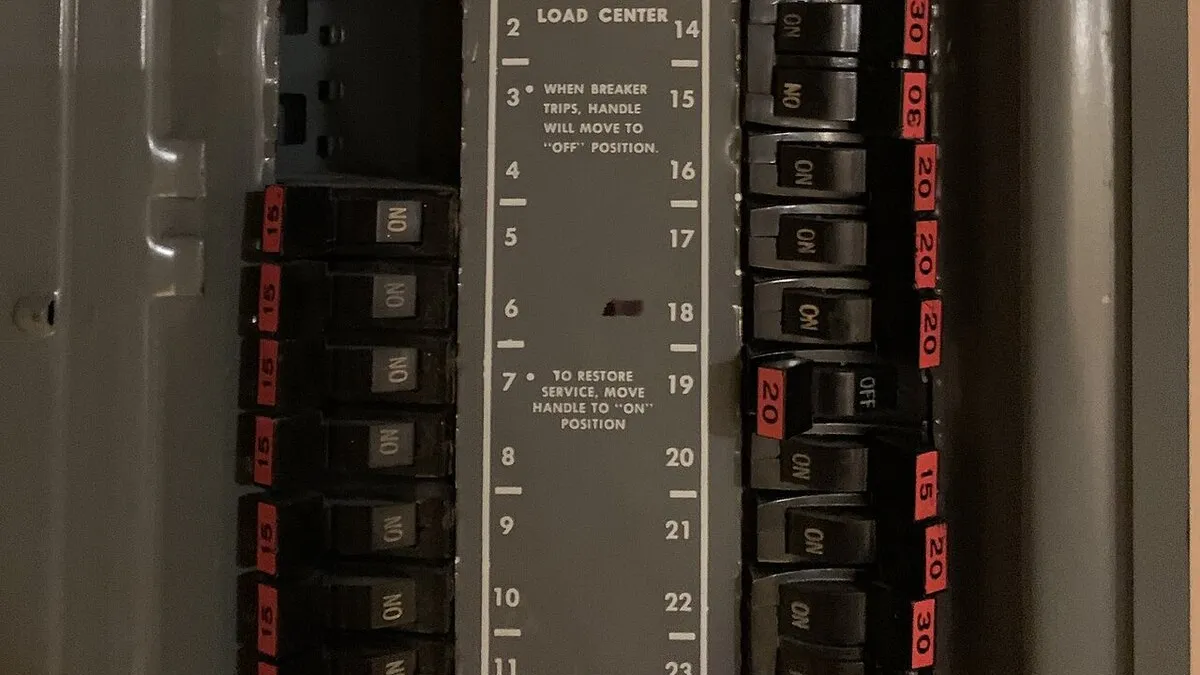
Photo: Repeater-reclaim, CC BY-SA 4.0, via Wikimedia Commons
The Panel the Home Inspector Circled
You are buying a house in Ann Arbor, or your insurance agent is filling out a renewal, and someone asks what brand your breaker box is. You open the door and there it is, a label that says Federal Pacific Electric.
A Federal Pacific panel is one of the most common items inspectors flag in older homes. It helps to know what the panel is, what the government actually said about it and what to do next.
What a Federal Pacific Panel Is
Federal Pacific Electric, often shortened to FPE, made residential breaker panels sold under the Stab-Lok name. They were widely installed in homes built from the 1950s through the 1980s, which covers a lot of Washtenaw County housing.
The company is long gone. A panel can look fine and work for decades, and that is why many owners never think about it until a sale or a renewal brings it up.
How to Tell If You Have a Federal Pacific Panel
You can check without touching anything inside. Open the panel door, which is safe, and leave the inner cover screwed on.
- The words Federal Pacific Electric, FPE or Stab-Lok on the door or the panel face
- Thin breakers with red or orange numbers or markings
- A panel in a home built roughly from the 1950s to the early 1980s
If you cannot tell, take a clear photo of the label and the breakers and call us at (734) 210-7667.
What the CPSC Said About Federal Pacific Breakers
This is where the internet gets loud, so it helps to stay with the record. In the early 1980s the Consumer Product Safety Commission investigated Stab-Lok breakers after FPE’s parent company reported that many did not fully meet UL requirements.
According to the Commission’s 1983 notice, its testing confirmed some calibration test failures, but it could not tie them to a specific hazard with the data it had. It closed the investigation without deciding whether the breakers are safe, and said it could reopen the matter.
So the honest summary is mixed. There was no clearance, and there was no final finding. Inspectors and insurers treat the panels with caution as a result.
Why Inspectors and Insurers Flag Them
A breaker exists to open the circuit when something goes wrong. If a breaker does not trip when it should, nothing stops the wires from heating. The concern with these panels is that reliability, and it is hard to confirm by looking at the panel.
For a buyer or an insurer, the safe approach is to remove the question. That is why Federal Pacific panel replacement often shows up on a repair request or a renewal checklist. Some insurers ask about the panel, and some may require replacement. Policies vary, so ask your agent.
What to Do Until the Panel Is Replaced
There is no need to panic, but there is a reason to plan. In the meantime a few habits help.
- Do not run several large appliances on one circuit at once
- Do not keep resetting a breaker that trips repeatedly. Call us instead
- Never remove the inner cover or swap breakers yourself
- Tell us about warm spots, buzzing, flickering lights or burning smells
A warm panel or a burning smell is urgent. Turn off what you safely can and call. Our guide to why your breaker keeps tripping explains what a trip is telling you.
What Replacing a Federal Pacific Panel Involves
We recommend replacing the whole panel, not just the breakers. A swap of breakers leaves the original connections in place.
A typical job starts with a walkthrough to confirm the panel type and check the service. We pull the permit, then remove the old panel, install a new one, label every circuit and add arc-fault and ground-fault protection where code calls for it. An inspector reviews the work before the job is closed.
Michigan requires a permit for this kind of work, and the City of Ann Arbor issues electrical permits through its building department. We handle the paperwork and coordinate with DTE if power has to be shut off at the meter.
A Good Time to Check the Service Size
A new panel is the best time to ask whether the service still fits the house. If you are adding an EV charger or a heat pump, a load calculation shows how much room you have. Our guide to 100 amp vs 200 amp service explains the process, and a 200 amp service upgrade can be done in the same visit.
It is also a natural moment to add a whole-house surge protector.
Selling or Buying a Home With a Federal Pacific Panel
If you are selling, replacing the panel before you list takes it off the table. If you are buying, a written estimate from an electrician gives you a number to work with during negotiation.
An electrical inspection can also check for other items in older homes, like ungrounded outlets or old wiring. Our guide to knob and tube wiring insurance in Michigan covers a similar situation for older wiring.
Replacing a Federal Pacific Panel in Ann Arbor
Send a photo of the label, or have us look at it in person. We tell you what you have and explain your options before any work starts, and the estimate costs nothing.
Current Electrical Systems has served Ann Arbor since 1994 with union electricians from IBEW Local 252. Work is billed by time and material with no scheduling fee, as our pricing page explains. Contact us to book a walkthrough.